
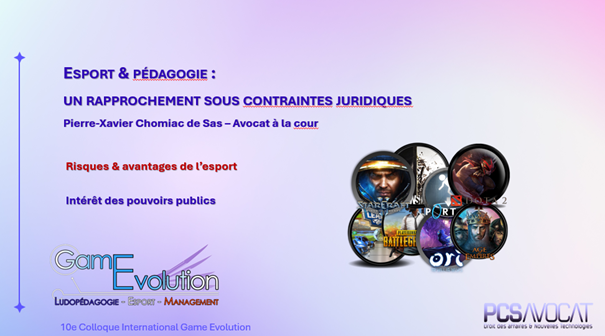
On May 13, 2026, the law firm PCS Avocat participated in the 10th International Game Evolution Symposium, organized by Antoine Chollet (University of Montpellier) and Philippe Lépinard (University of Paris-Est Créteil), on the theme of “Game-Based Learning – Esports – Management.”
Pierre-Xavier Chomiac de Sas presented a paper entitled “Esports & Pedagogy: A Convergence Under Legal Constraints,” examining the legal conditions for integrating esports into education. Far from being a neutral educational tool, esports operates within a private, contractual, and competitive ecosystem dominated by publisher power—a dynamic that directly conflicts with the principles of public education.
Watch the full conference here:
10th Game Evolution Conference
For ten years, the international Game Evolution Conference has brought together researchers and practitioners to explore the uses of games—video games, board games, role-playing games, and wargames—as tools for learning, managerial innovation, and organizational reflection. This tenth edition, organized by Antoine Chollet (Montpellier Research in Management) and Philippe Lépinard (Institute for Management Research), was held online with Twitch streaming, featuring four thematic sessions and several plenary sessions.
The firm’s presentation took place in Session 3 — “The Game-Based Learning Ecosystem and Beyond” — alongside presentations on acquiring managerial skills through game-based learning, organizational choices for implementing a Babel role-playing game in a business school, and the sector-specific characteristics of tabletop role-playing games in France and Italy.
Esports: An Ecosystem Difficult to Integrate with Education
The video game industry has long been the subject of misconceptions regarding its effects — particularly on young people. Conversely, a growing number of academic studies are now exploring the educational value of video games, leveraging their immersive, simulation, and cooperative capabilities. Within this movement, esports benefits from relative goodwill, perceived as combining sporting values and digital skills.
However, the presentation highlighted a structural contradiction: esports is primarily a private, contractual, commercial, and competitive sector, whose educational use faces two sets of obstacles.
A sector under private control: the power of the publisher
Unlike traditional sports, the medium of esports competition—the video game—is a work of the mind over which the publisher retains legal and technical control. This control is exercised on three cumulative levels. First, on the legal level, access to the game requires consent to an End User License Agreement (EULA) and the competition rules, from which publishers derive broad sanctioning powers (account suspension, prosecution for copyright infringement). The educational exception in Article L. 122-5 of the French Intellectual Property Code does not appear to encompass the esports and educational use of video games.
Furthermore, from a technical standpoint, the mandatory connection to online servers and accounts, combined with the dematerialization of media, deprives players of full and stable autonomy over the games they access (on these issues, see our publication RLDI 2024.11 — Video Games & Virtual Goods: A Property Struggle Between Publishers and Players). Several precedents illustrate the instability of video games as an educational tool: the removal of Fortnite from mobile platforms during the Epic Games/Apple dispute; the shutdown of The Crew servers by Ubisoft.
Finally, from an evolutionary standpoint, automatic updates can profoundly alter game content and its associated age rating, integrate new monetization mechanisms, dark patterns, or modify moderation policies (see our guide Video Games, Dark Patterns & Dynamic Pricing).
A legally complex sector: esports law
Law No. 2016-1321 of October 7, 2016, for a Digital Republic, provided France with its first legal framework governing video game competitions (organizational conditions, professional player status), while denying them the classification of a sport. This foundation was further defined by Decrees No. 2017-871 and No. 2017-872 of May 9, 2017. More recently, a bill “for responsible and attractive esports,” introduced on November 18, 2025, aims to modernize this framework.
Beyond this core, esports draws upon a complex array of regulations—communications law, platform liability, advertising and consumer law, personal data protection, intellectual property, and software law—in addition to the specific rules applicable to each category of stakeholders (publishers, clubs, players, organizers, broadcasters, sponsors).
This architecture, based on contractual freedom and the primacy of the private sector, directly conflicts with the requirements of the public education service: neutrality, transparency, equal access, and student protection. Schools cannot freely accept clauses that limit students’ rights or subject educational activities to unilateral rules set by private companies.
Esports: An Activity Compatible with Education Under Certain Conditions
While the esports ecosystem presents structural incompatibilities with education, the presentation argued that a reconciliation remains possible, under two conditions: a thorough understanding of the risks imported from the sector into schools, and a controlled division of responsibilities between private and public actors.
The Importation of Esports Risks into Education
The pedagogical practice of esports exposes its users to the effects of a model designed for entertainment and performance. Five risk categories have been identified: (i) screen time and its health consequences (sleep deprivation, sedentary lifestyle, chronic illnesses); (ii) the addictive nature of certain games, which can foster cyberaddiction; (iii) psychological difficulties common in the intensive sports sector (stress, injuries, metabolic disorders—see our guide “Esports Player, Health & Law”); (iv) media exposure linked to streaming and content creation practices, which is particularly concerning among teenagers; (v) tensions and toxic behaviors in a competitive school setting (exclusion, harassment, online bullying).
In addition to these risks, there is a potential imbalance in the teacher-student relationship itself: the teacher may find themselves losing authority in the face of game rules and mechanics that ultimately remain dictated by the publisher and its commercial objectives.
Adapting Responsibilities in the School Setting
The school setting cannot adopt the objectives of professional clubs—profitability, image monetization, and sponsorship strategies. It is the responsibility of those involved in educational esports to respect the obligations specific to the organization of such activities: user licenses, integrity and security of competitions, administrative declarations, student protection, equipment compliance, and cheating prevention.
The protections provided by the Labor Code for professional esports players appear inapplicable in an educational context. Responsibility then falls to other stakeholders: the event organizer (obligations of Article R. 324-3 of the Internal Security Code regarding the prohibition of participation of minors under twelve years of age in competitions with monetary prizes, and of Article R. 324-4 of the Internal Security Code regarding the requirement for written parental authorization); and the minor’s legal guardians, who are responsible for the protection and supervision of their child. The game publisher is liable under the duty to inform consumers (Decree No. 96-360 of April 23, 1996) and the protection of minors through the PEGI rating system established by Articles 32 and 33 of Law No. 98-468 of June 17, 1998.
The school and its headteacher are also bound by an obligation of safety and supervision towards students: compliance of equipment, legality of the games used, appropriateness of content, respect for the GDPR and image rights, and prevention of psychosocial risks specific to competition. The liability of public authorities could be invoked, to a lesser extent, insofar as they assume, finance, or participate in the physical or digital organization of the activities.
Esports and Game-Based Learning: A Developing Legal Framework
This oral presentation is based on a feature article—”Esports & Pedagogy: A Convergence Under Legal Constraints”—which expands on these analyses, structured around two parts (the structural incompatibility of esports with education / conditions for reconciliation) and supported by some twenty case law, doctrinal, and institutional references.
The full article will be published soon in a legal journal. Specific references will be added to this publication as they become available.
The firm thanks Antoine Chollet (University of Montpellier) and Philippe Lépinard (University of Paris-Est Créteil) for organizing the event and inviting them to speak, the directors of the MRM and IRG laboratories, as well as all the speakers and participants for the quality of the discussions during this tenth edition of the conference.
Pour aller plus loin