
Presentation
On 15 October 2026, Pierre-Xavier Chomiac de Sas spoke at the 2nd Thematic Research Day on “Consumption and Video Games”, organised by IAE Lille with the LUMEN research laboratory.
Prepared with Sophie Roman, our paper addressed the legal issues raised by dark patterns in the video game industry and their implications for the protection of players as consumers. Dark patterns in video games resist any stable legal classification. Consumer law, the Digital Services Act and the AI Act can sanction certain practices, but only in a fragmented way. Only co-regulation bringing together publishers, authorities and platforms will effectively protect players as consumers.
We would like to thank Marine Boyaval and all the organisers for their invitation, as well as Sarah Wiecek, Anne-Marie Lebrun, Patrick Bouchet and Ilana Bouhafs for the quality of the discussion during our session.
See the full event programme: Programme of the day
Consumption and Video Games – IAE Lille Conference
Held entirely online because of events on campus, the 2nd Thematic Research Day on “Consumption and Video Games” brought researchers and practitioners together at IAE Lille for two keynotes, a round table and two paper sessions. The approaches were wide-ranging: in-game advertising, gamification, player communities, influencer marketing, and the social and psychological effects of video games.
Our study was presented in the session “Player Consideration and Gaming Experience”. It sat alongside Sarah Wiecek, Anne-Marie Lebrun and Patrick Bouchet, on consumer exclusion, and Ilana Bouhafs, on reflexivity and learning in the Beer Game.
The day also featured keynotes by Olivier Nicolas and Adam Attouk (“Toxicity and Video Games”), and a round table on video games as cultural heritage. Speakers discussed at length how versions of video games are obtained and preserved as heritage, and the specific role of the French National Library (BnF). They also discussed the bill tabled in the French National Assembly on 15 September 2026 by Ugo Bernalicis and several MPs from La France Insoumise, which aims to guarantee players’ rights and the long-term survival of video games.
See our contribution to the BnF conference on these issues: 2026.06 – BnF Conference – Protecting Video Game Heritage: Law & Video Games

Dark Patterns – A Concept Without a Legal Category
A dark pattern is an interface technique designed to change users’ behaviour beyond their original intention. The definition is convenient, but it does not trigger any legal regime of its own.
The core difficulty lies in a boundary. On one side is the incentive that guides players in their own interest: level design that steers them towards the objective, a relevant recommendation. On the other is manipulation that exploits their cognitive biases to their detriment.
The industry has developed its own mechanisms, which fall into four families:
- Time. Daily rewards conditional on logging back in, forced advertising, sessions with no natural stopping point.
- Money. Intermediate virtual currencies that blur the real price, pay-to-skip, and power creep that makes past purchases obsolete.
- Social. Fear of missing out (FOMO), peer pressure, forced invitations.
- Psychological levers. Collection mechanics, the illusion of progress, random rewards.
Three criteria combine to classify a mechanism: its effect on the player (uncontrolled spending, signs of addiction), the player’s degree of awareness or acceptance, and the publisher’s intent. Recent cases against major publishers illustrate this shift from playful design to manipulation.
Video Games – An Interface That Conceals Manipulation
Research on dark patterns first focused on simple interfaces: cookie banners, e-commerce sites, intermediation platforms. A pre-ticked box or a labyrinthine cancellation process is fairly easy to spot there.
Video games are far more complex. Their incentive mechanisms blend into thousands of elements that the game itself needs. Grinding, dynamic difficulty adjustment or AI-driven personalised recommendations can improve the experience just as easily as exploit it.
It therefore seems appropriate to focus on how each technique is configured and what it is for, rather than on how it looks. The same progression system is legitimate if it rewards skill, and questionable if it is calibrated to make purchasing all but inevitable.
That leaves the evidential hurdle. Players only see the interface. The settings, A/B tests and behavioural data stay with the publisher. Proving manipulative intent or effect requires access to what the publisher does not disclose.
Our guide to dark patterns and dynamic pricing in video games
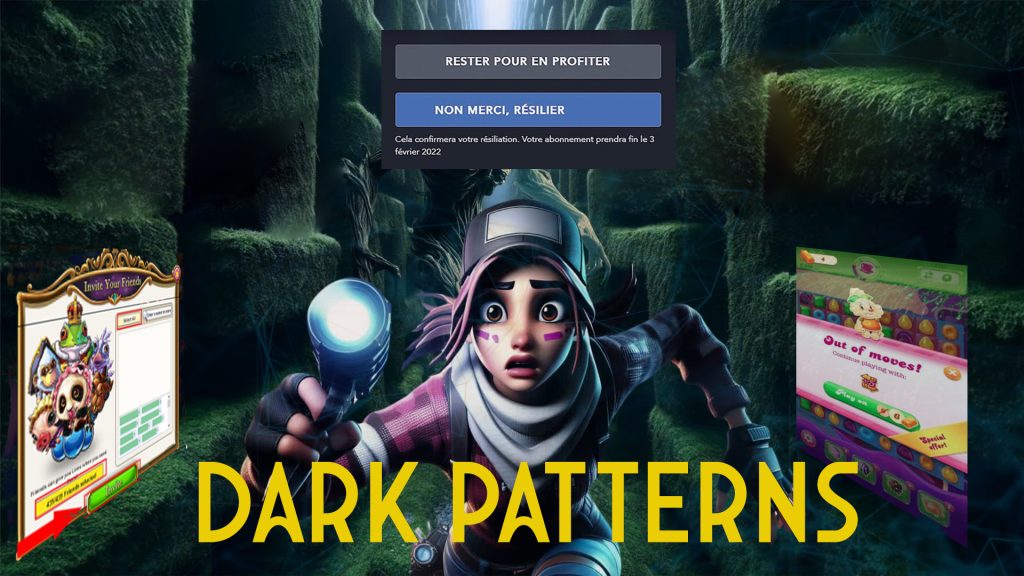
Dark Patterns and Consumer Law – A Fragmented Legal Toolkit
Traditional contract law tools are poorly suited to the specific practices of the video game industry. The right of withdrawal, defects in consent and the product liability regime all assume a single, identifiable decision. In video games, however, the player makes hundreds of micro-decisions over the life of the game.
The very nature of the relationship further complicates the legal analysis. Players hold only a licence to use the game, as recently confirmed by the French Supreme Court in UFC-Que Choisir v. Valve (Cass. civ. 1re, 23 Oct. 2024). The guarantees attached to the sale of goods therefore apply poorly.
Our study on the ownership of virtual goods (RLDI, 2024)
These obstacles have not, however, prevented the first sanctions, based on the law of unfair commercial practices.
- Netherlands. On 14 May 2024, the Dutch Authority for Consumers and Markets (ACM) fined Epic Games €1.125 million for practices targeting children in the Fortnite item shop: misleading countdown timers and direct exhortations to buy. The Rotterdam District Court upheld the fine on 14 January 2026.
- United States. In March 2023, the Federal Trade Commission (FTC) finalised an order requiring Epic Games to pay $245 million in refunds. It targeted a button configuration that triggered unintended purchases, and purchases made by children without parental consent.
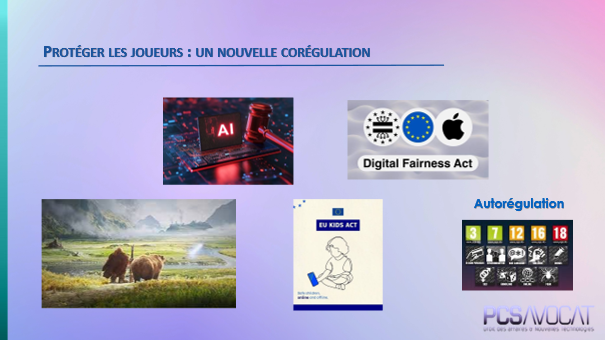
The European and French frameworks have also grown denser, yet without forming a fully unified whole.
| Instrument | What it targets | Limits for video games |
|---|---|---|
| Unfair Commercial Practices Directive 2005/29/EC | Misleading and aggressive practices | Case-by-case assessment, with the burden of proof on the authority or the consumer |
| DSA, Article 25 | Deceptive or manipulative interfaces | Applies only to online platforms, and only residually: practices already covered by Directive 2005/29/EC or the GDPR are excluded |
| AI Act, Article 5(1)(b) | AI systems exploiting age-related vulnerabilities, prohibited since 2 February 2025 | Requires an AI system, a material distortion of behaviour and significant harm |
| JONUM (SREN Act, Arts 40 and 41; Decree No. 2026-60 of 4 February 2026) | Games with monetisable digital objects: prior declaration to the ANJ, minors excluded, capped rewards | Three-year experimental regime that does not cover conventional loot boxes |
| PEGI criteria (applicable since June 2026) | Paid random items rated PEGI 16 at minimum | Self-regulation, applying only to games submitted after June 2026 |
On Article 25 of the DSA, the nuance is decisive. The prohibition already exists, but a game publisher is only subject to it if it operates an online platform within the meaning of the Regulation. For most studios, the 2005 Directive remains the reference point.
The forthcoming Digital Fairness Act, announced by the European Commission, could explicitly target addictive mechanics.
Protecting Video Game Players – Pathways to Co-regulation
In closing our paper, we argued that only co-regulation, involving publishers, authorities, platforms and player associations, can offer a durable and stable solution for player protection. We proposed five complementary pathways:
- A sector-specific framework. Transpose to video games the categories already used by the FTC (deception, obstructed cancellation, hidden costs), enriched with mechanics specific to gameplay.
- Algorithmic transparency. Overcome the evidential hurdle by imposing audit obligations on publishers with large audiences, modelled on those the DSA provides for recommender systems.
- Protection of minors. Strengthen existing tools: PEGI ratings, parental controls, age verification.
- Extending the JONUM approach. Apply to conventional monetisation mechanics (loot boxes, battle passes) the tools already imposed on JONUM: capped rewards and self-limitation of spending and playing time.
- Contractual separation. Separate purchases from the game’s licence of use, so that they are fully subject to consumer law.
For studios, the stakes are immediate. The line between legitimate incentive and manipulation is drawn at the design stage, and it must be documented. A mechanism whose purpose is written down, tested and justifiable will withstand scrutiny better than one optimised for conversion alone.
Video Games and Monetisation – Lawyer Specialising in Digital Law
A free-to-play model now plays out as much in the in-game shop as in the gameplay itself. A wrongly classified monetisation mechanic exposes the publisher to sanctions, a PEGI reclassification and class action.
PCS Avocat practises video game law and advises:
- Studios and publishers: legal audit and classification of monetisation mechanics, in-game shops and reward systems.
- Distribution and online gaming platforms: compliance with Article 25 of the DSA and the rules on unfair commercial practices.
- JONUM operators: structuring the offer and filing the prior declaration with the ANJ (French National Gambling Authority).
- Publishers using AI (recommendation, dynamic pricing): analysis under Article 5 of the AI Act and the GDPR.
- Contract drafting: EULAs, terms of sale for in-game content and virtual currencies.
- Associations and players: defending their rights against abusive practices.
Further reading
- Our guide to dark patterns and dynamic pricing in video games
- Video game players’ rights against EULAs and account bans
- Our study on the ownership of virtual goods (RLDI, 2024)
- Our talk on loot box regulation at the Gam(bl)ing Conference
- All the firm’s talks and publications
- Programme of the 2nd Research Day “Consumption and Video Games”
Sources & References
- ACM – jugement du tribunal de Rotterdam du 14 janvier 2026 (Epic Games)
- ACM – décision sur réclamation du 27 novembre 2024
- FTC – ordonnance finalisée contre Epic Games (245 M$)
- DSA, article 25 (texte consolidé)
- AI Act, article 5 : interdictions applicables depuis le 2 février 2025
- Décret n° 2026-60 du 4 février 2026 (JONUM)
- PEGI – nouveaux critères annoncés le 12 mars 2026, applicables en juin 2026