Presentation
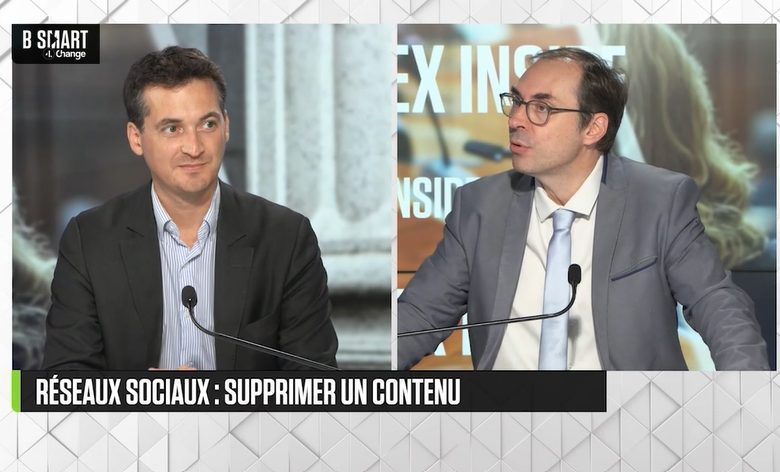
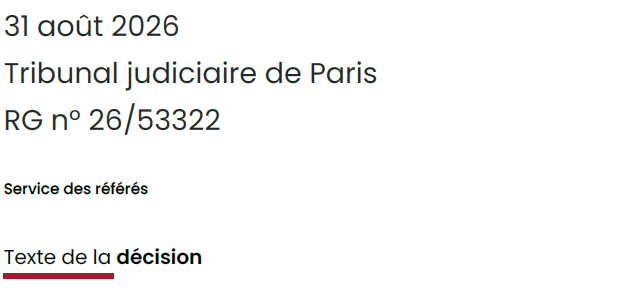
On October 27, 2026, Pierre-Xavier Chomiac de Sas was the guest of Lex Inside (in French), the legal show hosted by Arnaud Dumourier on the French business channel Bsmart. Under the title “Réseaux sociaux : supprimer un contenu” (“Social media: removing content”), the founder of PCS Avocat discussed a judgment handed down by the Paris Judicial Court on August 31, 2026. The case pitted a talent agency and two DJs against Meta, operator of Instagram.
Based on the French Act of June 21, 2004 on confidence in the digital economy (LCEN), the decision shows what victims can ask of platforms when they want to remove content from social media. Before ordering the removal of posts, or even of an account, the court must assess each act individually, together with its civil and criminal consequences.
In this case, content amounting to threats, harassment, doxing and unlawful photomontages can be removed at the victim’s request. Defamatory accusations, however, generally escape removal, since their author is not a party to the proceedings. More notably, deleting an entire account and keyword filtering remain available under French law, provided they are strictly targeted and proportionate.
Cyberharassment campaign on Instagram – The facts before the court
The facts. After their business relationship ended in 2025, a talent agency representing hard techno artists and the former head of its US subsidiary took their dispute to Instagram. From February 2026, the former executive posted a series of stories targeting the agency and several of its artists. The effect was troubling, to say the least: the account grew from 3,920 to more than 57,000 followers within a few months.
The online campaign combined several types of content:
- accusations of sexual abuse, including of minors, and of domestic violence;
- threatening images: the Grim Reaper, a knife, firearms, “Sent here to kill you,” “hit squad”;
- disclosure of a DJ’s home address and a $25,000 offer to hack accounts;
- undisclosed photomontages and a call on followers to leave bad reviews of the victims’ law firm.
Reported to Instagram in February and March 2026, the posts stayed online, as Meta considered them lawful. On April 28, 2026, the agency and the two DJs sued Meta Platforms Ireland. They sought removal of the posts, deletion of the account and, for 24 months, keyword-based filtering of content associated with the victims.
Ruling under the French expedited procedure on the merits (procédure accélérée au fond), the civil court delivered a measured response for the victims, carefully distinguishing each act and its consequences. The judgment may still be appealed.
Removing content from social media – A necessary sorting exercise
A flexible legal basis. Article 6-3 of the LCEN, introduced by the French Act of May 21, 2024 to secure and regulate the digital space (SREN Act), sets only two conditions: harm, and a person able to help stop it. Hosting providers fall into that category. This remedy is central to the legal advice we provide to digital businesses (in French) facing illegal content.
Key provision – Article 6-3 of the LCEN (unofficial translation)
“The president of the judicial court, ruling under the expedited procedure on the merits, may order any person able to contribute thereto to take any measures capable of preventing harm or stopping harm caused by the content of an online public communication service.” Original text on Légifrance
Limits set by the court. A measure may be ordered only if it is justified by the harm, legally permissible and proportionate. It must not disproportionately infringe the author’s rights under Articles 8 and 10 of the European Convention on Human Rights.
A provisional characterization. Lacking jurisdiction over the author’s criminal liability, the civil court characterizes the facts “subject to” the assessment of the criminal courts. On that basis, it finds that the posts may amount to several digital criminal law (in French) offenses under the French Criminal Code (Code pénal):
- death threats (Article 222-17 of the Criminal Code);
- cyberharassment (Article 222-33-2-2 of the Criminal Code);
- doxing (Article 223-1-1 of the Criminal Code), as the disclosure of the address occurred in a context likely to prompt physical attacks;
- undisclosed photomontages (Article 226-8 of the Criminal Code).
Removal obtained during the proceedings. In an important contextual detail, Meta deleted the threatening and harassing stories before the judgment, so the victims’ removal request had become moot. The court therefore dismissed it as having no further purpose. It nevertheless ordered Meta to pay the costs: the request was well founded, and removal occurred only after the victims filed suit.
A distinctive feature of French law, Article 6-3 lets victims act directly against the hosting provider, without first suing the author.

Online defamation – A limit on removal by the host
Because the victims also alleged defamation, the court had to conduct a specific analysis reflecting the features of this press offense.
Article 29 of the French Press Freedom Act of July 29, 1881 defines defamation as “any allegation or imputation of a fact that damages the honor or reputation of the person” (unofficial translation). When committed publicly against a private individual, it is punishable under Article 32. The author may defend themselves by proving the truth of the facts or by establishing good faith.
An author absent from the proceedings. According to the court, the accusations of sexual abuse and domestic violence amount to public defamation of a private individual. Yet the court declines to order their removal. The action is brought by the victim against the host, not against the author. Without adversarial debate, the court may order removal only if the content is manifestly unlawful.
The judgment follows two rulings of February 26, 2025 by the French Supreme Court (Cour de cassation) (Cass. civ. 1re, Feb. 26, 2025, No. 23-16.762 and No. 23-22.386). Damage to the honor or reputation of the persons targeted is not enough to establish manifest unlawfulness. The court may, however, take into account prior defamation convictions of the author for identical statements.
A difference in legal regime. Although more serious than an image of the Grim Reaper, the accusation of pedophilia stays online. A threat is unlawful in itself. An accusation is unlawful only if it is false or made in bad faith, which only a debate with its author can establish.
The insult route. The judgment also notes that some posts targeting the second DJ, likening him to a “caveman” or calling him a “trash ass promoter,” may constitute public insult (injure publique). Since truth is no defense to insult, this characterization might have led to a different assessment, although the judgment draws no conclusion from it.
For defamatory statements, the standard route remains an action against the author. It faces, however, the short three-month limitation period of Article 65 of the 1881 Act. Identifying the author quickly therefore becomes a priority. This short period is a distinctive feature of French press law and often surprises foreign claimants.

Deleting an Instagram account – A measure of last resort
A proportionality test. Blocking a website or an account must be appropriate, strictly necessary to stop the harm and proportionate to the aim pursued. The court relies on the European Court of Human Rights (ECtHR, June 23, 2020, OOO Flavus and Others v. Russia, No. 12468/15, § 37). Wholesale deletion affects lawful and unlawful content alike.
At the time of the first judicial officer’s report, the account held 576 posts, most of them about music events. The evidence filed to show that posting continued did not establish that such posts were its only content, nor that they kept the same threatening tone.
Deletion could be considered if the account “persisted in its campaign of threats and cyberharassment” despite the judgment. An account dedicated exclusively to illegal content, or one that persists after a first ruling, could therefore be deleted.
The claims against two other accounts failed for a simpler reason. The writ of summons gave no URLs for the posts, and no screenshots were filed. Successive reports drawn up by a judicial officer (commissaire de justice) would, by contrast, document the share of illegal content and the persistence of the conduct.
Hosting providers and filtering – Meta under French law and the DSA
Host or publisher – A shifting boundary
Host versus publisher. A publisher is liable for the content it publishes. A hosting provider, which merely provides technical means for users to share content, enjoys limited liability. Enshrined in the LCEN, this regime is restated in Article 6 of Regulation (EU) 2022/2065 on digital services (Digital Services Act, DSA): a host is liable only if it fails to act expeditiously once aware of the illegality. In this case, Meta was treated “as a hosting provider,” and that status was not disputed.
The active role. Recent case law, however, narrows access to this regime. It denies host status where a platform exercises control over content or acquires knowledge of it. Three 2026 decisions illustrate the trend:
- Cass. com., Jan. 7, 2026, No. 23-22.723 (binding rules, “superhost” label, promotion of listings);
- CJEU, June 16, 2026, WebGroup Czech Republic and NKL Associates, C-188/24, and Coyote System, C-190/24 (algorithmic predetermination of the order of priority in which content is displayed);
- CJEU, July 16, 2026, AGCOM v. Google, C-421/24 (review of a channel with a view to a paid partnership).
The power to decide what stays online. The Paris Court of Appeal relied on a body of evidence against a review platform (CA Paris, May 29, 2026, No. 23/04781). Its terms of use reserved a discretionary right to delete, filter, translate or modify content. It had issued two reasoned refusals to remove content, one of them presented as a “final decision.”
What the court focuses on is not the clause itself, but the power it confers: deciding what remains online. The Aix-en-Provence Court of Appeal likewise found that a boat rental website, which described itself as a publisher, played an active role (CA Aix-en-Provence, Aug. 6, 2026, No. 24/07955).
An open question for social networks. Social networks rank content algorithmically, set posting rules and give reasons when they refuse removal. Meta had indeed refused to remove the reported content. These factors may fuel, in other cases, a debate over host status. Stripped of this regime, a social network would be liable for content as a publisher.
Keyword filtering – The ban on general monitoring
A request admissible in principle in France. Article 8 of the DSA prohibits imposing on intermediary service providers any general obligation to monitor content or actively seek facts. Article 9 of the DSA, by contrast, allows judicial authorities to order action against specific items of illegal content, on the basis of national law.
The court concludes that it may order targeted monitoring, since Article 6-3 of the LCEN provides the procedural route. This reasoning is consistent with the ruling relied on by the claimants (CJEU, Oct. 3, 2019, Glawischnig-Piesczek, C-18/18). It also shows how French courts now read national remedies through the lens of the DSA.
An overly broad request. The claimants sought an automated filter for 24 months, in all languages. It was to cover the account, any similar username, their names and a long list of keywords: “mort” (death), “sexe” (sex), “kill,” “predator,” “promoters,” and so on. The court rejected it on two grounds. The measure would have removed accusations whose removal is not permitted. The generality of the keywords, including a common first name, would also have caught content unrelated to the case.
Filtering is therefore not prohibited: the filter requested simply lacked precision. A list of everyday words would effectively leave the platform to assess legality, which the DSA rules out.
Illegal online content – Digital Law Attorney in France
When an online campaign strikes, the quality of the file built before any action often determines what a court will be able to order. PCS Avocat advises businesses and professionals facing these issues:
- Individuals and companies targeted by an online campaign: characterization of content, separating threats, harassment and defamation, removal strategy;
- Artists, content creators and agencies: building evidence through successive judicial officer reports, notices to platforms and formal notices;
- Executives facing reputational attacks: notices under Article 16 of the DSA and follow-up on platform responses;
- Platforms and online services: drafting terms of use and moderation procedures, assessing the risk of losing host status;
- Litigation counsel: preparing the file and targeted requests under Article 6-3 of the LCEN.
Learn more about the firm’s digital law practice (in French).
Further reading
- Replay of the Lex Inside show of October 27, 2026 on Bsmart (in French)
- Our digital law practice (in French)
- Our digital criminal law practice (in French)
- All of the firm’s publications and speaking engagements (in French)
The firm thanks Arnaud Dumourier and the Bsmart team for their invitation. For any question on removing online content or platform moderation, contact the firm.