Presentation
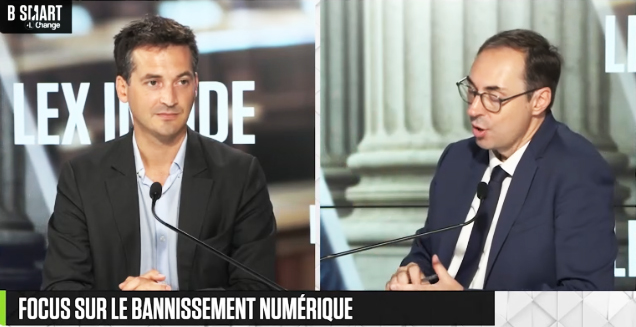
On September 4, 2026, Pierre-Xavier Chomiac de Sas appeared on the program Lex Inside to answer questions from Arnaud Dumourier regarding the Nice Court’s decision on August 5, 2026—the first ruling to impose a “digital ban” penalty.
This appearance follows the firm’s previous interviews covering topics such as cybersecurity, esports, and video games. You can view an overview of our past appearances on B Smart here.
PCS Avocat’s discussion focused on the specific characteristics of the video game industry—a sector frequently targeted by cyberattacks—as well as the practices that heighten these risks, the consequences for players and professionals, the legal avenues for defense, and the measures studios can take to protect themselves and combat these threats.
The Jean Pormanove Case – Influencers Sentenced to a Digital Ban
The new penalty of a digital ban was handed down during the trial of two online content creators involved in a 2025 tragedy, in which an influencer died while livestreaming on the Kick platform.
Find out more about the Nice Court’s ruling and its implications in our dedicated article.
“Digital Ban” – The SREN Act and Combating Online Offenses
Introduced by the “SREN” Act of May 21, 2024—aimed at securing and regulating the digital space—the new “digital ban” penalty aligns with the Act’s dual objective: fostering accountability among digital service providers and better regulating illegal online behavior.
This penalty allows for the suspension of access accounts for online platform services used to commit offenses, as well as a ban on creating new accounts on said platforms.
The legislation refers to online platform services that may include, first and foremost, social networks, but also content-sharing platforms such as YouTube, Twitch, or Dailymotion, as well as marketplaces and intermediation platforms whose primary activity involves posting information online or facilitating communication.
Ban on accessing online platforms – Cyberharassment and counterfeiting.
This penalty represents a genuine innovation regarding the offenses to which it is now linked, although the extensive list of such offenses raises questions about the advisability of making it a penalty of general application.
However, this penalty echoes a similar provision in the Intellectual Property Code, which stipulates that “when the offense is committed via an online public communication service, persons found guilty of the offenses provided for [acts of counterfeiting] may also be sentenced to the additional penalty of suspension of access to an online public communication service for a maximum period of one year, coupled with a ban on entering into another contract for a service of the same nature with any operator during that same period.”
“Digital ban” and online offenses – a dual status
This new measure has a more complex status than that of a simple new criminal penalty. Indeed, a digital ban can be imposed in several circumstances:
Prior to formal judicial proceedings, it can be considered as a measure ordered as part of a criminal settlement (composition pénale), as a condition of a suspended sentence with probation, or as a security measure ordered under judicial supervision.
Digital ban & Minors. Also incorporated into the Juvenile Criminal Justice Code, the digital ban loses its classification as a criminal penalty there, becoming instead an educational measure that can therefore apply to minors under the age of 13.
General ban on accessing social networks and freedom of expression and communication
A source of concern upon its announcement, the digital ban was perceived by some as a means for the State to bar individuals from accessing social networks or, more broadly, the Internet. However, the text applies only to online platforms specifically used to commit the offenses for which the perpetrators were convicted. As this constitutes a criminal penalty, it is subject to judicial review regarding proportionality vis-à-vis fundamental freedoms, such as freedom of expression or communication.
Online platforms, social networks, and content creators – Lawyer specializing in digital law
The civil and criminal liability of content creators and influencers involves a wide range of scattered legal provisions: the Consumer Code, the Commercial Code, the Penal Code, the 1881 Law on Press Offenses, advertising regulations, the GDPR, the DSA and DMA, etc. Ensuring compliance—for both content publishers and online platforms (hosting providers held accountable under the 2004 LCEN Law, as supplemented by the DSA and the SREN Law)—requires rigor and a mastery of the legal issues inherent in their activities.
PCS Avocat assists professionals, platform creators, influencers, and online content creators with all aspects of digital compliance, as well as issues related to liability and content moderation.