Table of Contents
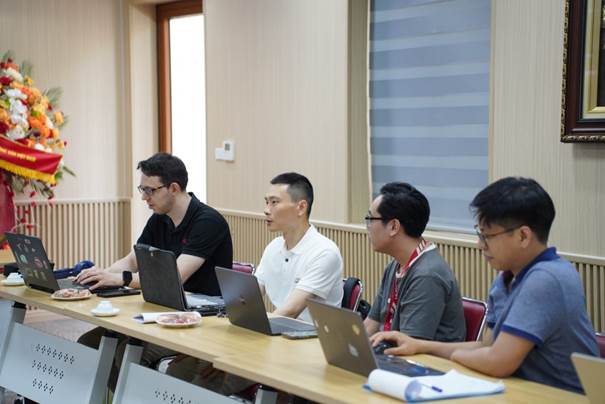
On 21 and 22 May 2026, Maître Pierre-Xavier Chomiac de Sas had the honour of speaking at the international conference co-organised by the law faculties of the University of Montpellier and the University of Hanoi, devoted to the contemporary legal issues raised by esports.
These three presentations outline the contours of an emerging body of esports law: identified stakeholders whose respective liabilities remain unclearly allocated, a legal classification suspended between two regimes, and contracts whose drafting directly determines the legal certainty of clubs and players alike. The field is evolving, the labour courts are beginning to issue rulings, and the legislative framework remains to be consolidated. These issues are of direct concern to clubs, organisations, publishers and agents operating in the sector — please do not hesitate to contact me to discuss them.
The firm regularly advises and acts in negotiations for stakeholders in the esports and video game industries — clubs, organisers, publishers and players — on the full range of these issues: drafting and legal classification of player contracts, structuring relationships with partners and sponsors, protection of image rights and intellectual property rights, and regulatory compliance. These conference engagements form part of that day-to-day practice and provide an opportunity to share its insights with the professional and academic community.
Esports Conference: Montpellier–Hanoi Partnership on Comparative Esports Law
Bringing together academics, practitioners and industry professionals around a comparative Franco-Vietnamese approach, this event provided an opportunity to examine the existing legal tools applicable to a sector in the midst of rapid structuring. The international dimension of the conference allowed perspectives to be broadened: while France has pioneering legislation governing esports, the globalisation of talent and competitions calls for analysis that extends well beyond national borders.
PCS Avocat contributed to three working sessions addressing matters at the heart of the sector’s current concerns: (i) the legal protection of players’ health, (ii) whether esports may be classified as a sport within the meaning of French law, and (iii) the contractual framework applicable to professional players.
These presentations afforded an opportunity to test current positive law against the practical realities of the sector, drawing on situations encountered through our advisory and negotiation practice for stakeholders in the esports and video game industries.


Esports & Video Games: Legal Protection of Esports Players’ Health
The rise of esports, sustained by substantial investment and a structural model patterned on the Olympic framework, has transformed players into genuine professionals, exposed to physical and psychological risks that are now well documented.
See our publication on minor esports players.
The professional player operates at the intersection of three spheres, each carrying distinct risks. In the video game sphere, the player is exposed to addictive mechanisms linked to “gamblification” and to publishers’ aggressive marketing strategies. On the competitive side, the player is subject to constant performance pressure, doping risks and musculoskeletal disorders associated with intensive training. Finally, the digital environment exposes the player to cyberharassment, eye strain and the complex issues surrounding the image rights of the player-as-influencer.
Protection rests on an allocation of obligations among several entities. The club, as employer, is legally bound by a duty of safety — although the tendency to resort to service-provider status in order to reduce social charges exposes such structures to a serious risk of judicial reclassification. The competition organiser is responsible for ensuring compliance with age thresholds and obtaining parental authorisations. The publisher exercises a contractual policing power over the rules, server access and a power to impose sanctions on clubs. Parents remain the guardians of the earnings of minor players, which must be deposited with the Caisse des Dépôts.
French law, through the 2016 statute and recent legislative proposals, seeks to regulate these practices. However, effective protection of players can only be achieved through a regulatory framework engaging all stakeholders in the sector.
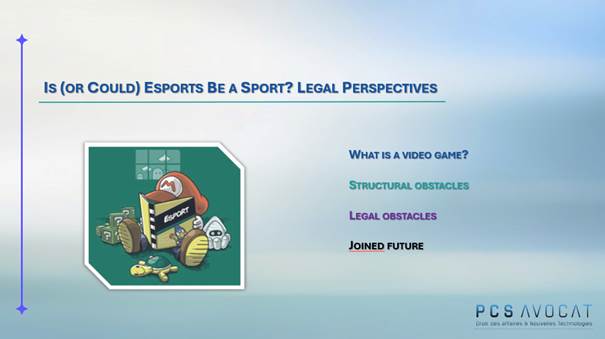
Sport and Esports – Closely Related Sectors but Legally Distinct
Esports has developed by replicating the organisational model of the sports sector. The legislature has nevertheless declined to apply sports law to it, on grounds of a twofold divergence: the nature of the video game as the medium of competition, and the question of its exploitation rights.
Any legal alignment of the two activities runs up against the artistic nature of the video game, which prevails over its sporting characteristics. Furthermore, treating esports competition as a sport raises a significant risk: that of potentially making any digital activity eligible for sporting status, with incalculable consequences.
A second structural obstacle: esports remains dependent on publishers, who own the intellectual property rights. Publishers exercise discretionary control over the rules, server access and the very existence of each discipline — creating a legal dependency that has no equivalent in traditional sports federations.
The two sectors nevertheless remain deeply intertwined. Sport was one of the earliest sources of inspiration for video games, and many contemporary titles offer sporting experiences through virtual reality and connected devices. The esports sector continues to grow steadily, marked by a persistent mimicry of sport: leagues, teams, business models and fan communities.
Against this background, France has stood out for the strength of its institutional support. It is notable that, notwithstanding the formal exclusion of esports from the sports regime, the vast majority of State initiatives in its favour have been undertaken directly by, or in coordination with, the ministries and directorates responsible for sport.
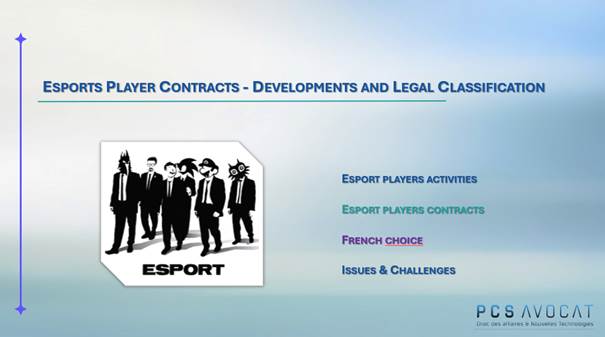
Esports Player Contracts: Developments and Legal Classifications
The growth of the esports economy has required a professionalisation of contractual relationships, which have long been marked by significant legal uncertainty. While esports borrows its conventions from traditional sport, its digital nature gives rise to specific features in terms of player duties, intellectual property and exploitation of players’ image rights.
The 2016 Digital Republic Act introduced a specific fixed-term employment contract for professional esports players. Many organisations nevertheless continue to favour service-provider agreements — an apparent flexibility that exposes clubs to a substantial risk of reclassification as an employment contract whenever a legal relationship of subordination is established. Several rulings to this effect have been handed down in recent years.
The scope of players’ duties is now multidimensional, combining competitive performance and ancillary activities relating to influencer work, modelling and even sport. Contractual drafting must reflect this with precision, as must clauses on remuneration, equipment requirements, health and transfer conditions. Specific child-protection provisions applicable to minor players add a further dimension.
Current thinking encourages a revision of the originally envisaged statutory framework, although no settled solution has yet emerged — particularly against a background of the growing internationalisation of esports talent, which further complicates the question of legal classification and applicable regimes.
Esports & Video Game Law: 2026 PCS Avocat Engagements
This conference is part of the firm’s ongoing engagement and public speaking on the legal issues raised by esports and video games. Over the past few weeks, several professional events have provided an opportunity to address these topics from a range of perspectives:
Game Changers – Women, Law & Esports: Legal Overview of Esports and the Player’s Counsel
Digital Week – Gaming Law: Video Games, Esports & the Platform Economy
Game Evolution Conference – Game-Based Learning and Esports: Connections and Constraints