Contents
- Introduction and stakeholders of Esports
- The legal regime of esports and the status of the professional player
- The place and role of the lawyer in the esports ecosystem
- Media exposure of female players and platform liability
- Legal framework of esports: necessary and sufficient regulation?
- Further reading
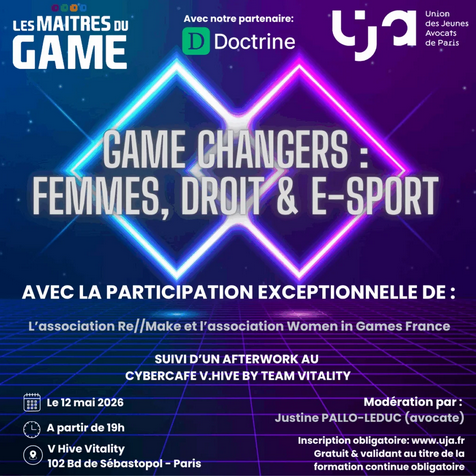
On the occasion of the event “Game Changers: Women, Law & E-sport,” held on 12 May 2026 in Paris by the lawyers’ association Les Maîtres du Game and the Union des Jeunes Avocats de Paris (UJA Paris), the firm PCS Avocat took part alongside Me Anna Loubière (Enthropy firm), under the moderation of Me Justine Pallo-Leduc.
Titled “Legal overview of e-sport & the lawyer advising the e-sport player,” this first round table reviewed the legal framework applicable to esports and the role of the lawyer in this ecosystem, before giving the floor to Raphaëlle Cordes (journalist and sports commentator, founder of POG tv), Me Laura Ben Kemoun (LBK Avocats), the Re//Make association and the Women in Games France association represented by Anna Bressan, to present and contextualise the place of women in today’s esports ecosystem.
Presentation and Esports professionnals
Esports is legally defined as a video game competition. This deliberately broad definition reflects the impossibility of fixing both an exhaustive list of games and the criteria for identifying an esports competition. It also extends the absence of a strict definition of sport in French law, which rests more on a body of indicia laid down by the administrative courts than on a clear-cut qualification (see our publication “2025.12.15 – Is esports a sport?”).
The esports ecosystem brings together a particularly wide range of stakeholders: video game publishers (owners of the works underlying the competitions), esports clubs and structures, professional players, support staff (coaches, analysts, mental and physical trainers), agents, competition organisers, broadcasters and streaming platforms, commentators and content creators, as well as peripheral professions (professional associations, lobbyists, production companies).
This diversity of stakeholders explains the complexity of the legal issues encountered, each being subject to its own regime and to specific contractual relationships (for more information, see our book “Droit et métiers de l’esport” published by Ellipses).
The mapping of esports stakeholders shows a marked gender imbalance — professional female players, women heading clubs, event organisers, journalists and specialist casters, and legal advisers within the ecosystem all remain in the minority.
The Re//Make and Women in Games France associations highlighted on this occasion the importance of giving visibility to this female presence and of questioning the structural obstacles to balanced representation.
The legal regime of esports and the status of the professional player
Law No. 2016-1321 of 7 October 2016 for a Digital Republic gave France a legal regime specific to esports — one of the first in Europe. The legislature deliberately excluded the application of the sport regime, the video game underlying the competition remaining a work of the mind, the intellectual property of its publisher.
Article 102 of this law in particular introduced a dedicated employment contract for salaried professional players, directly modelled on the fixed-term sports contract (CDD sportif). In practice, this scheme remains little or not at all used by industry participants: its conditions are seen as difficult to implement and too restrictive for clubs, which sustains an ongoing risk of reclassification of contractual relationships.
Beyond this foundation, esports involves many other regimes: intellectual property (ownership of rights in the game and its content), advertising and sponsorship law, platform liability (hosting providers, online public communication services), audiovisual communication law, GDPR (mass collection of player and spectator data), as well as the new frameworks applicable to artificial intelligence.
The “women’s” competitions organised by certain publishers and organisers raise, in this context, major issues: instability of women’s leagues, precariousness of female players’ contracts compared to men’s, systematic disparities in remuneration, eligibility criteria, articulation with open competitions, and the treatment of female players identified as such for promotional or marketing purposes.
The place and role of the lawyer in the esports ecosystem
When asked about this question, the lawyer intervenes in several capacities within the esports ecosystem. They first act as adviser to the various professionals — publishers, clubs, organisers, players, agents, broadcasters — on all the legal issues raised by their activity: structuring, contracts, intellectual property, regulatory compliance, litigation.
The lawyer may also carry out mediation work, in particular to resolve disputes between players and clubs or between organisers and competition participants, and may also assist clients through the status of esports agent (contract negotiation, structuring of partnership relationships).
This plurality of roles requires an in-depth knowledge of the ecosystem, of how publishers operate and of the specific features of competitions. PCS Avocat handles these matters within its dedicated E-sport & video games practice.
Media exposure of female players and platform liability
The media exposure of esports athletes — through streaming, official competitions and clubs’ communications — exposes them to heightened risks, in particular cyberharassment, doxing and, more generally, all press offences. These attacks may originate on social networks, broadcasting platforms or the chat features built into the video games themselves.
Female players and content creators in the esports sector are statistically more exposed to certain forms of cyberviolence, in particular of a sexist or sexual nature. This was highlighted in particular during the round tables organised by the French Senate on sexism in video games and streaming and in esports.
This reality calls for contractual vigilance (protective clauses in club–player contracts, support for structures), prompt activation of platforms’ reporting mechanisms and, where appropriate, legal action on the basis of press offences and the criminal provisions applicable to cyberharassment.
The liability of the platforms concerned — publishers, social networks, broadcasting platforms — crystallises around the distinction between hosting provider and editor and the conditions for its application. This dichotomy, inherited from the French Law on Confidence in the Digital Economy and now supplemented by the European Digital Services Act (DSA), determines the scope of the applicable obligations: removal of manifestly unlawful content, proactive moderation or otherwise, traceability, and reporting mechanisms.
The effective protection of players is made more complex by an operational reality: while all platforms share a common legal foundation, each has its own terms of service, its own acquisition and retention strategies, and its own tolerance regarding freedom of expression and moderation. The result is uneven protection, calling for strategies tailored on a case-by-case basis (reporting, formal notice, legal action, referral to the competent authorities).
Legal framework of esports: necessary and sufficient regulation?
Esports brings together a large number of stakeholders with sometimes divergent interests: publishers and game creators, players, staff and clubs, event organisers, broadcasters and commentators, peripheral professions (agents, associations, lobbyists). The French legal framework alone cannot resolve all the issues raised by this plurality.
The sector is now organising itself around a co-regulatory approach, structured in four stages: (i) the implementation by professionals themselves of good practices; (ii) the periodic monitoring and oversight of all stakeholders; (iii) the legislative endorsement of proven good practices; and (iv) the sanctioning of demonstrated abuses.
This model can already be seen on several topics: oversight of advertising practices, the fight against misleading commercial practices, the treatment of loot boxes, regulation of esports betting, and the protection of minors. It calls for ongoing dialogue between economic actors, authorities (ARCOM, ANJ, CNIL, DGCCRF), associations and legal advisers.
Structuring the place of women in the esports ecosystem also falls within a co-regulatory logic: good-practice agreements led by associations (Re//Make, Women in Games France), charters adopted by clubs and event organisers, partnerships with women’s or mixed competitions. This momentum would benefit from being gradually integrated into the contractual and regulatory arrangements applicable to the sector.
Further reading