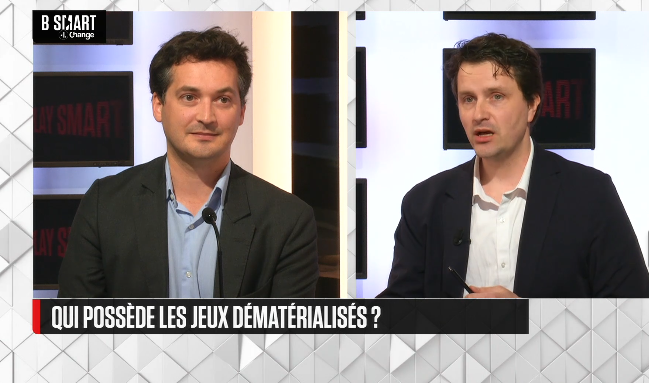
On April 28, 2025, the law firm PCS Avocat was interviewed by Nicolas Jucha on the Play Smart program to discuss the complex issue of video game ownership, particularly in its digital format.
Invited alongside Morgane Falaize (President and Co-founder of Women In Games France, Minuit Douze), Mickaël Dell’ova (founder and game designer of EthicAll Games), and Anne Dévouassoux (President and Chief Operating Officer of SNJV, Spiders/Nacon), Pierre Xavier Chomiac de Sas presented the landmark legal dispute between the consumer association UFC Que Choisir and the video game distribution platform Steam.
The Play Smart program also explored topics related to the role of women in the French video game industry and the use of video games as a tool for social inclusion.
Find the link to the full interview here: https://www.bsmart.fr/video/28437-play-smart-01-mai-2025
Play Smart / B Smart: an online media outlet dedicated to the video game industry
Launched in 2025, the show Playsmart, broadcast on the B Smart channel and hosted by Nicolas Jucha, is dedicated to the video game industry.
Through thirty-minute segments, the show analyzes the economic, technological, social, and geopolitical challenges of the video game sector, featuring industry professionals and experts to decipher current events, market trends, and the major issues facing the world of video games, both in France and internationally.
“Playing is good, playing smart is better,” the show’s slogan, reflects its aim to provide in-depth and insightful analysis of the gaming world, including its particularly interesting legal issues.
UFC Que Choisir vs. Steam: Exhaustion of rights in the field of video games
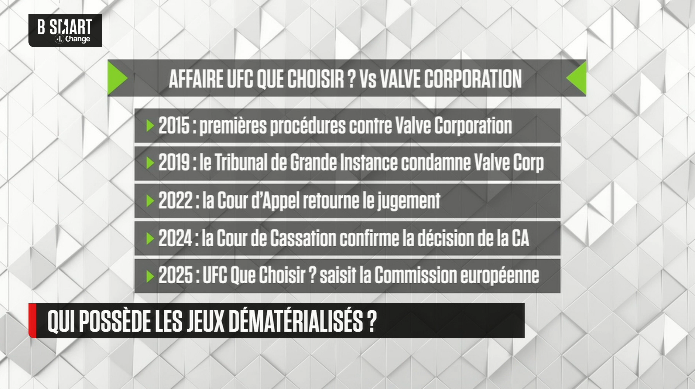
The legal dispute, which began in 2015, was initially resolved in favor of the consumer association UFC Que Choisir by the Paris Judicial Court. The clause in Steam’s terms and conditions prohibiting the resale of accounts or digital video games purchased on the platform was deemed abusive and disproportionately infringing on players’ rights.
In a widely discussed ruling dated October 21, 2022, the Paris Court of Appeal overturned the lower court’s decision, finding the clause in question to be valid. The Court’s reasoning was based on the interpretation of European directives governing copyright and software.
The Court considers that Directive 2001/29 on “general” copyright applies, unlike Directive 2009/24/EC specific to software. It follows that there is no exhaustion of rights for digital video games.
Another important element in this decision is that the Court of Appeal declined to refer a preliminary question to the Court of Justice of the European Union regarding the interpretation of these directives: “Should Article 4(2) of Directive 2009/24 and Article 4(2) of Directive 2001/29 be interpreted as meaning that the right to distribute a digital copy of a video game is exhausted when the purchaser has made that copy, with the authorization of the rights holder and in exchange for remuneration corresponding to the economic value of that copy, by downloading a copy of the computer program enabling the use of the video game on a computer via the Internet?”
UFC Que Choisir vs Steam – Appeal: Are video games subject to software law?
The case was ultimately brought before the Court of Cassation, which challenged the rejection of the referral of this complex issue to the European courts. According to the association, video games fall under the software directive and not general copyright law. Indeed, the distinction between the exhaustion of rights for tangible and intangible copies is not applicable to the video game copy market, where there is no difference between copies on physical or digital media. Therefore, the clause in question should be deemed null and void.
“that video game software is not an accessory and, by its nature, falls under Directive 2009/24/EC of the European Parliament and of the Council of 23 April 2009, and not Directive 2001/29/EC of the European Parliament and of the Council of 22 May 2001;
that, moreover, with regard to the market for video game copies, or the second-hand market, there is no difference depending on whether the copy is made from physical media or from the internet;
that, by holding otherwise, in order to reject the request for a preliminary ruling submitted by UFC Que Choisir, the Court of Appeal violated Directive 2009/24/EC of the European Parliament and of the Council of 23 April 2009 and Directive 2001/29/EC of the European Parliament and of the Council of 22 May 2001.”
By a judgment of the first civil chamber of 23 October 2024, the Court rejects the appeal and the claims of the association.
1st Civil Chamber, October 23, 2024 (23-13.738): Video games are complex works and not (anymore) simply software.
Regarding the exhaustion of rights, the Court adopts a cumulative interpretation of Article 4 of Directive 2001/29 on copyright and recitals 28 and 29 thereof, which stipulate that the exhaustion of rights does not apply to online services, as copyright includes the exclusive right to control the distribution of a work incorporated into tangible goods. In this respect, the Court cites the relevant judgments of the CJEU, in particular those of 22 January 2015, Art & Allposters International, C-419/13; 19 December 2019, Tom Kabinet, C-263/18; and 3 July 2012, UsedSoft, C-128/11.
She points out that the exhaustion of rights for tangible and intangible copies, which applies to software, is merely a special law and therefore inapplicable in this case. Indeed, a video game cannot be reduced to its software component and is protected as a complete work under general copyright law (CJEU 23 January 2014, Nintendo, C-355/12).
Unlike a computer program designed to be used until it becomes obsolete, a video game quickly reappears on the market once the game is finished and, unlike software, can still be used by new players several years after its creation.
In the absence of reasonable doubt regarding the interpretation of EU law, there is no need to refer a preliminary question to the CJEU.
UFC Que Choisir. Infringement proceedings and preliminary ruling
This solution did not satisfy the association, which decided to pursue a new legal avenue: an infringement procedure before the European Commission against France concerning the Steam dispute.
This procedure aims to challenge the refusal of the French courts to refer a preliminary question to the Court of Justice of the European Union (CJEU) regarding the possibility of reselling digital video games acquired on Steam, a question which, according to the association, falls under European law and the principle of exhaustion of rights.
Behind this action, UFC-Que Choisir hopes that the European Union will take a stand to guarantee equal treatment between physical games, whose resale is permitted, and digital games, currently subject to a resale ban on Steam.
The infringement proceedings are based on Article 258 of the Treaty on the Functioning of the European Union (TFEU), with the Commission ultimately deciding whether or not to bring an infringement action before the Court of Justice of the European Union (CJEU). Infringement proceedings are merely declaratory, and the CJEU cannot overturn the decision of the French Court of Cassation. Should both the Commission and the CJEU rule in favor of the infringement, France will be required to take the necessary measures to enforce the Court’s judgment, or face a financial penalty.

Video games and virtual currencies – other potentially deceptive business practices
The legal action against the Steam platform is part of a broader struggle waged by numerous European consumer protection associations against the video game industry.
On September 12, 2024, BEUC – the European Consumer Organisation – and 22 of its member organizations from 17 countries filed a complaint with the European Commission and the Consumer Protection Network (CPC-Network) denouncing several misleading practices by major video game publishers, including Activision Blizzard, Electronic Arts, Epic Games, Mojang Studios, Roblox Corporation, Supercell, and Ubisoft. These companies, which market particularly popular games – Fortnite Eat Sports, Minecraft, Clash of Clans, etc. – are accused of using unfair business practices and abusive terms to govern the use of virtual currency in connection with premium games.
Specifically targeted are clauses that waive consumer rights, particularly those allowing operators to unilaterally modify or remove game features, as well as those limiting consumers’ statutory rights. The complaint also denounces unfair terms related to the personalization of the consumer gaming experience.