
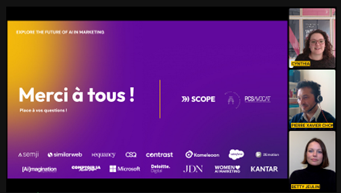
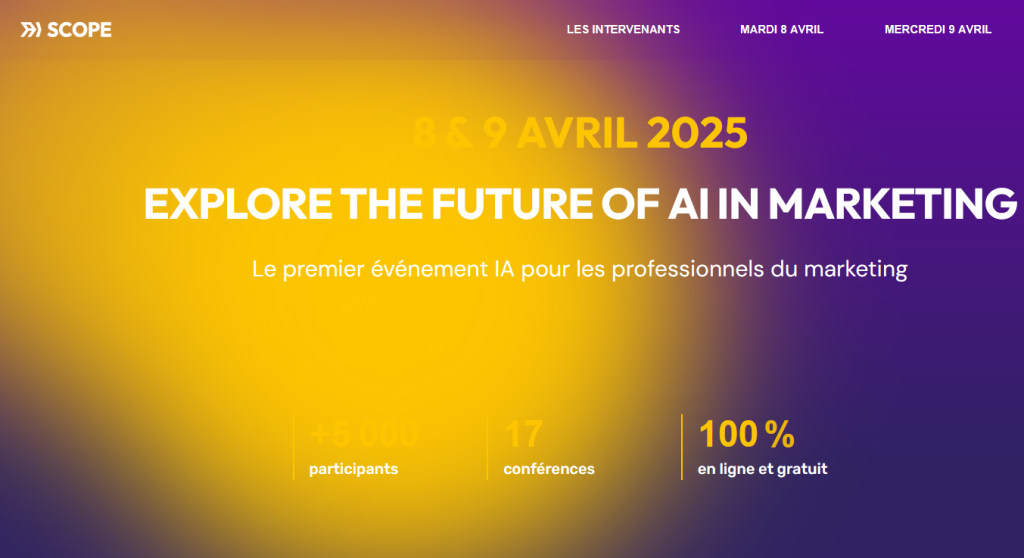
Semji, a marketing professional, organized a major event called “AI Scope” on April 8th and 9th, 2025, dedicated to addressing the topic of AI for marketing professionals. Seventeen online conferences were viewed by over five thousand participants eager to exchange ideas on innovations and strategies for effectively integrating AI into their processes and activities:
- How PAP used AI in its content strategy to boost performance
- AI & Video Creation: Productivity, Creativity… and Responsibility!
- From descriptive to predictive: AI at the service of marketing insights
Reinventing marketing in the age of AI: innovative strategies and use cases to maximize the impact of decision-makers
Invited to address the complex issue of AI, Chomiac de Sas, a specialist in digital law, and Betty Jeulin, an intellectual property lawyer, answered questions related to artificial intelligence law in just under an hour.
Our presentation focused on providing pragmatic answers to the legal questions and challenges raised by marketing professionals’ use of artificial intelligence tools.
Find the conference proceedings and our previous presentations on this topic online:

“AI and legal challenges: navigating between innovation and compliance”
In line with the digitization of society and services, the proliferation of tools using generative AI is disrupting established practices, requiring companies to be vigilant regarding the associated legal issues, particularly in marketing and advertising.
This presentation will cover not only the legal framework applicable to AI in marketing, but also identify and raise awareness of legal risks and best practices for ensuring optimal business security: access conditions, data protection, intellectual property rights, algorithmic transparency, contracts and clauses specific to AI, etc.
Legal risks in the use of AI: A Roadmap please
In short, professionals using AI tools may face legal risks in three forms: civil and judicial risks, criminal risks, and administrative risks, including non-compliance with applicable standards.
Within this threefold spectrum of liability, marketing agencies must consider the implications associated with the data stored in AI tools, the cognitive biases and hallucinations to which these tools are inevitably subject, the conditions for using the generated results, and the complex issue of data collected and reused by AI models.
Use of an AI tool: Contractual framework for missions
In the absence of a comprehensive and fully applicable legal or regulatory framework, the use of artificial intelligence tools by the public, whether professionals or consumers, is primarily governed by contract law.
It is up to the general terms and conditions of AI tools to define their obligations and responsibilities towards their users. Therefore, it is crucial for agencies to be particularly vigilant in analyzing these terms and conditions, and even, if necessary, to require contractual negotiation through a specific contract tailored to the company’s needs.
We are seeing more important clauses and objectives for agencies and their clients, particularly regarding complete information on the operation and processes associated with an artificial intelligence tool, the data processing involved (including personal data, business data, and trade secrets), and the guarantees concerning intellectual property and the confidentiality of operations performed and content generated.
Leveraging AI tools: the legal KYC of service providers
Following on from the points presented earlier, it is now essential for companies to establish procedures for analyzing and selecting the tools they wish to use or implement in their operations.
Among the relevant considerations are the legal entity that owns the solution: a startup with a client-facing solution or a company dedicated to improving the language model?
The same applies to the tools themselves: which LLMs should be prioritized and based on what criteria? Which databases must be submitted and why? What user journey should be prioritized given the company’s needs, and what about subcontractors and database mapping?
Finally, what guarantees are offered? Are these promotional and marketing statements associated with the offering, contractual obligations, compliance with ISO standards, or more generally, compliance with national, EU, and European regulations?

How, in reality, can we control the data transmitted to an AI tool?
The answer to this question is neither obvious nor simple. Experience shows that obtaining professional guarantees in the use of digital tools requires a multiplication of procedures and verifications to control and mitigate any potentially harmful risks to the company.
Requests for information on how the tools work, along with requests for technical and legal guarantees, are essential and can be obtained through technical and legal audits.
These due diligence measures, documented by professionals, are designed to prevent the agency from being held liable to its clients in the event of difficulties, particularly for negligence or a lack of due diligence expected of a professional in this sector.
AI & Compliance: GDPR, Cybersecurity & AI Act: So what?
In a professional environment characterized by an increasing number of applicable standards, it seems appropriate to view these regulations as a competitive opportunity for marketing agencies.
Indeed, compliance with standards regarding personal data, cybersecurity, the AI Act, and other elements enhances the experience, professionalism, and reliability of the companies involved. Bound by similar standards, industry players—clients and service providers alike—are sensitive to these obligations and will benefit from agencies that can expedite these processes.
Find the summary of our presentation on leveraging compliance with digital standards at the Documation forum.
Digital law specialist: Legally controlling the use of AI
It appears that professional marketing agencies have every reason to understand and master the content of artificial intelligence tool offerings by enlisting the help of qualified professionals to guide them in their choices.
Alongside technical experts, the advice and support of lawyers specializing in digital law or intellectual property can prove to be a major asset:
Data protection: Lawyers can help navigate the regulatory framework for personal data, particularly the GDPR, and ensure that the use of data by AI tools complies with applicable laws. Beyond the legal obligation, respecting customer data used in marketing campaigns is a valuable asset for the company.
Intellectual Property: As discussed in our previous presentations, the intellectual property rights of AI-generated content are not yet the subject of a clear consensus. Legal doctrine and initial global case law tend to favor the absence of intellectual property rights for such content, unless the user demonstrates an additional and personalized creative process.
It should be noted that the use of the prompt, particularly the wording of requests, does not currently appear to meet the originality criterion, which is mandatory to establish the existence of a work protected under the Intellectual Property Code.
Analyzing the terms and conditions, along with a preliminary strategy developed with legal counsel, ensures that AI-generated creations do not infringe existing intellectual property rights and that the rights to these creations are clearly defined.
Contracts and Partnerships: Considered on several occasions, marketing agencies can, and perhaps should, negotiate dedicated contracts with AI tool providers to clarify each party’s responsibilities in the event of a dispute.
Regulatory Compliance: Alongside these new tools, it is important to remember the existing legislation governing marketing agency services regarding online advertising, accurate and fair information, deceptive business practices, unfair competition, and counterfeiting.